IT and Business Alignment Is Not Enough. Why Financial Services Firms Need Convergence to Win.
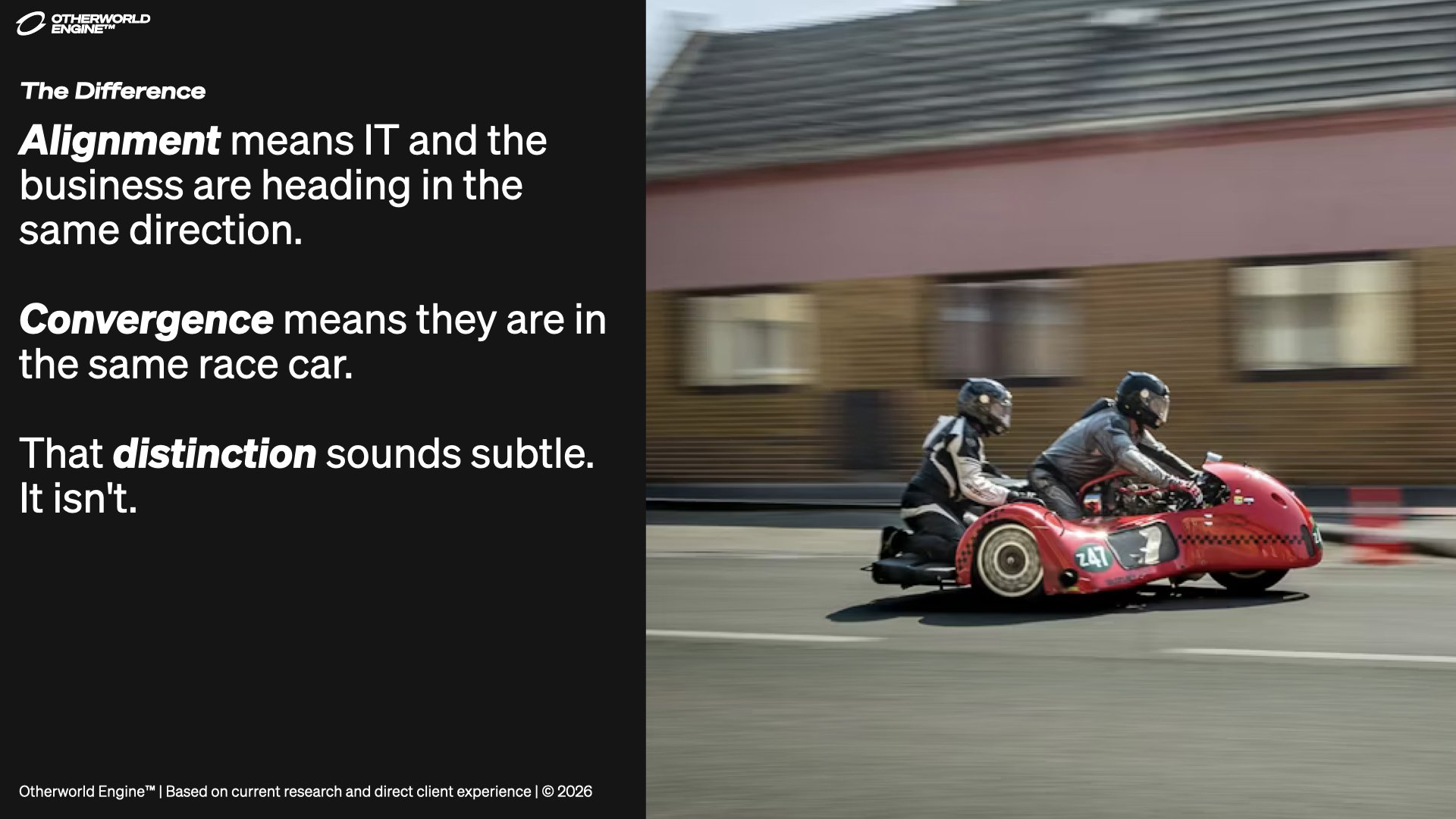
Alignment means IT and the business are heading in the same direction. Convergence means they are in the same race car. DBS Bank built a "two in a box" model where a business leader and a technology leader share the same KPIs. Not aligned. Accountable to the same outcome. That's convergence.
That distinction sounds subtle. It isn’t.
Alignment produces a cost center. A function that waits to be asked, told, or paid to participate. Skilled, available, and fundamentally disconnected from where decisions get made.
Convergence produces a value center. A function that studies the race before it starts. That knows which risks are building before they surface. That acts before the question gets formed.
Think about a F1 pit crew. They don't wait for the car to come in. Every move is already decided. Four tires in two seconds isn't improvisation. It's what happens when IT is engineered into the performance, not bolted on after the fact. Most financial services firms have built a mechanic's garage next to a race track and called it a strategy.
The DBS model isn’t an IT story, but it’s where the failure gets noticed first. But is it really an IT problem? Maybe it’s more an executive departmental level problem masked as an IT problem.
Let’s picture the same race car with five different departments each optimizing their own gauge. The CFO is watching fuel efficiency. The COO is watching lap time. The CIO is watching engine diagnostics. The CRO is watching tire wear. Each one is doing their job well. None of them is watching the race. A car built like that doesn't win, because any single gauge failed. It loses, because five people were each driving toward a different finish line at the same time.
That's what a cost-center looks like from the inside. Finance owns the P&L. Technology owns the roadmap. Operations owns the process. Each function converges internally, great alignment within the department, while the space between departments stays exactly as disconnected as it always was. What’s needed is one shared finish line, with each function accountable to where the car actually ends up, not just to their own gauge.
Convergence at the top isn't IT joining the business. It's the CFO, COO, and CIO sharing the same three or four numbers instead of each optimizing a different one and calling it strategy. When margin, throughput, and platform stability are the same conversation instead of three separate ones, the "whose priority is this" meeting stops happening. Now there's only one number left to argue about, and everyone in the room owns it.
The firms pulling ahead have made a different structural choice. Authority at the edge. Anticipation over reaction. IT deployed as a value center, not managed as a cost center.
That's convergence. And it doesn't happen by accident.
We look for this when we embed ourselves as partners to accelerate their performance to make an impact on their P/L with business performance engineering. We want to make sure the ‘readiness’ is actually there to make sure there aren’t any crashes down the road.