
Why Financial Systems Built Only to Run Are Losing Ground. Engineering Systems Built to Win.

Financial companies don't have a performance problem. They have an engineering problem. Most run on systems built only to operate, not to compound results over time.
The Otherworld Engine™ is an Intelligent Performance Operating System engineered around your business value drivers and P&L impact, designed to deliver measurable performance in weeks, not years.
To understand what that looks like in practice, it helps to borrow from a world that's already mastered engineering for performance: Formula 1. The Mercedes-AMG PU106C Hybrid didn't just power cars. It was engineered to compound performance race after race, season after season. The Otherworld Engine™ applies that same principle to financial services.
1. THE CHAMPIONSHIP RESULTS What the world sees on the podium.

Think of the Mercedes-AMG PU106C Hybrid as a metaphor, not a literal comparison — it's what happens when something is engineered for performance, not just built to function. Most financial companies are running the opposite: systems designed to operate, not to drive results. The Otherworld Engine™ flips that. It's a business engine engineered specifically for performance — and the numbers show it: 35% reduction in legacy system maintenance costs, 25% higher operational output per team, 20% faster delivery of new financial products, and 30% less manual work and fewer FTEs across operations.
2. BUILDING THE ENGINE What happens in the garage that the podium never shows.
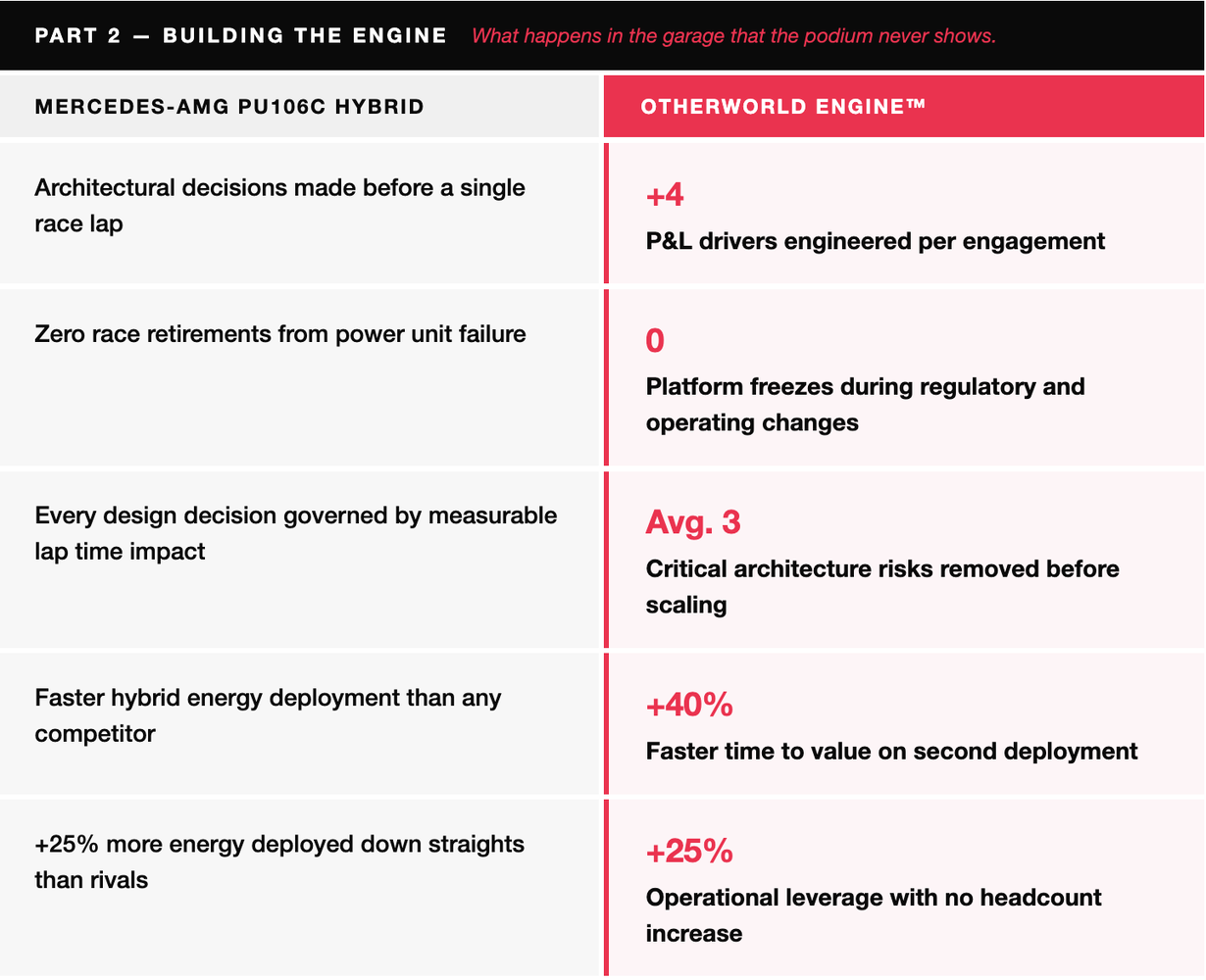
This is the engineering work that happens before results ever show up. The Otherworld Engine™ builds in 4 P&L drivers per engagement, removes an average of 3 critical architecture risks before scaling, and eliminates platform freezes during regulatory or operating changes entirely. Deployment gets faster too — 40% faster time to value on a second deployment, plus 25% more operational leverage with no added headcount.
3. THE ENGINE'S PERFORMANCE SPECIFICATIONS The specs that explain why it wins.

These are the specs behind the performance. 70% of production behavior is reused and proven before deployment, and 73% of critical business processes are covered on day one. The system accounts for 200–300 documented exception and edge case paths per core process, with 16 years of average traceable execution history behind every automated decision. Time to first measurable value: 4–6 weeks.
The greatest drivers in Formula 1 history will tell you the same thing. Talent gets you to the grid. The engine determines whether you win.
In financial services, the companies that dominate the next decade will not win, because they ran the best transformation program. They will win because they made a different decision to stop operating and start performing.
Engineering with a winning ethos is not a philosophy. It is a practice. It is the discipline of building systems that compound performance over time, eliminate the risk before it scales, and deliver measurable advantage from day one.
The financial industry already has enough engines that run.
The ones built to win are rare. And the distance between the two is everything.