Why Your AI Investment Isn't Moving the P&L And What CFOs Must Fix.

The market moves faster than your operating model. Instead of reimagining how work should fundamentally change, CXOs optimize narrow efficiency gains within functions. Incremental improvements dressed up as transformation and never getting material gains.
Here's what Forrester’s Accelerate Your AI Voyage found: 43% of AI decision-makers measure productivity gains. 41% track efficiency. But only 32% tie AI outcomes to revenue or profit.
Saving 10,000 employee hours looks good on paper. It won't cover the tech bill. Let alone drive reinvention. What’s your AI strategy?
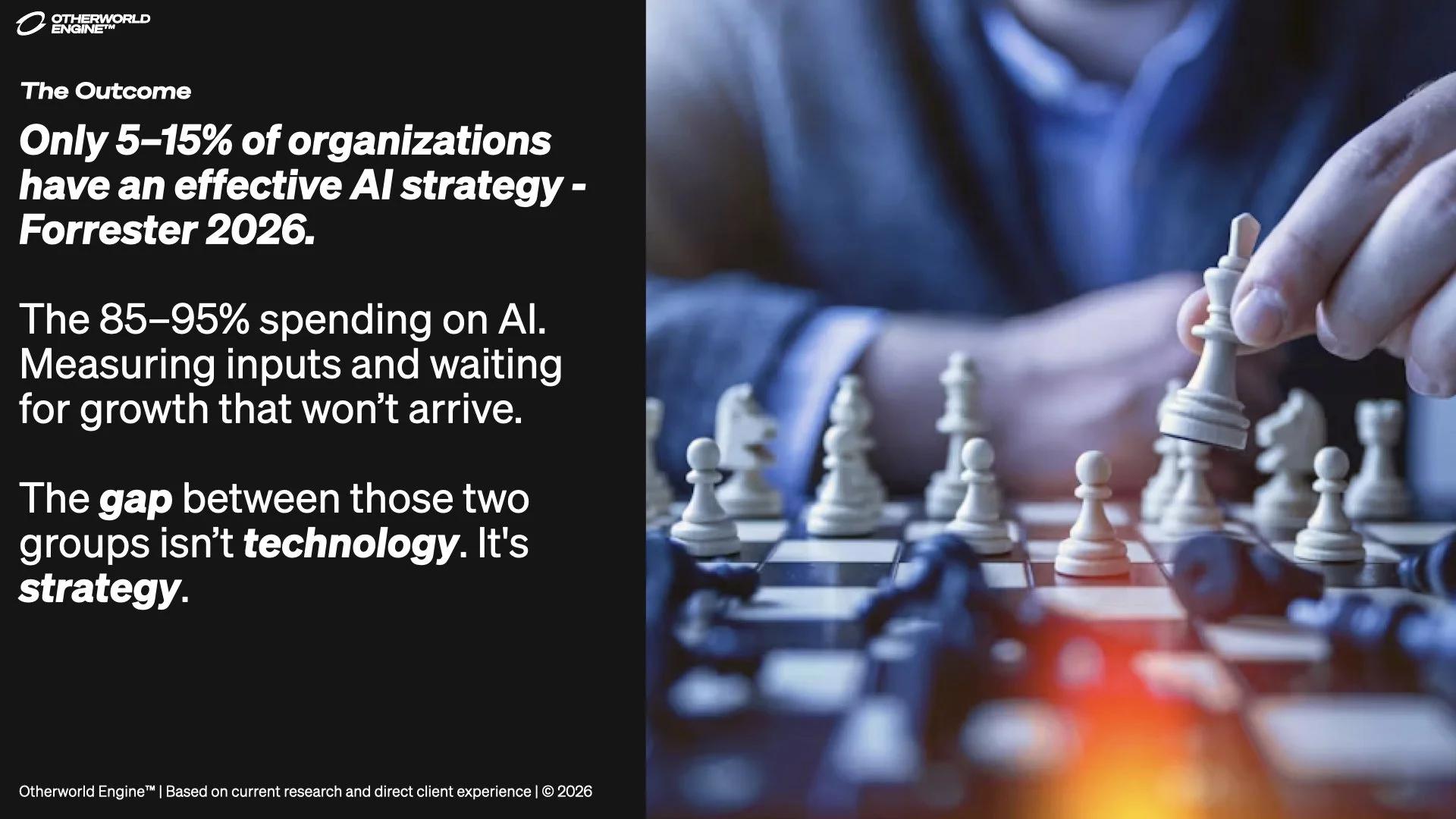
Only 5–15% of organizations have an effective AI strategy according to Forrester.
Handing employees a Copilot or ChatGPT and waiting to see what happens isn't a strategy. It's a bet that incremental will somehow become transformational. It won’t.
Efficiency isn't an AI strategy. Bolting AI onto a broken workflow just makes the broken thing faster.
If your AI program disappeared tomorrow, would your P&L notice?
Here's the mechanism nobody talks about. Productivity gains and P&L impact are not the same metric, and treating them as interchangeable is how AI budgets get burned. An employee saving two hours a week on data entry is a real gain. But if that time gets absorbed into more meetings, more email, more of the same low-value work, the P&L never sees it. The hours disappear into the organization instead of showing up as revenue, margin, or headcount avoided.
This is why the 32% figure from Forrester matters more than the other two. Measuring productivity and efficiency is easy. Measuring whether any of it reached the bottom line requires an operating model that was built to convert time savings into financial outcomes in the first place. Most weren't. So the AI sits on top of a workflow that was never designed to translate speed into money, and the result is exactly what CFOs are reporting: real activity, no material impact.
The fix isn't more AI tools. It's rebuilding the handful of processes that actually touch revenue and cost, so that when AI removes friction from them, the P&L has somewhere to catch the value. That's a smaller, harder project than a company-wide pilot rollout. It's also the only version of this that shows up in next year's numbers.
There’s a governance angle to this challenge. Who’s owning the responsibility for AI governance in their own organization? If finance doesn't own how AI initiatives get measured against financial outcomes, no one is positioned to capture the value even when it's available. The tooling and the accountability for converting it into profit margin sit in different parts of the organization, which is a structural reason the P&L never sees it, not just an execution gap. So, having a defined P/L ownership structure, even a shared one, is key to successfully rolling out AI projects.
This doesn’t mean AI adoption should stop. It means that 4-to-6-week diagnostic discovery may now have more value than it ever did. This diagnostic discovery needs to identify which 2 or 3 processes actually touch revenue and cost. It then needs to evaluate a company’s AI adoption readiness in parallel to remove risks to failed AI adoption. Both a readiness assessment and discovery, had to happen before the rollout, not as a retrospective explanation for why last year's AI pilot didn't move profit margin.
This is why we prefer to take a business performance engineering approach to make sure we help our partners impact their P/L in big ways.